
Open enough furnace cabinets and you stop seeing “a heat exchanger.” You start seeing three different animals that happen to do the same job.
I’ve watched technicians with ten years in the trade hesitate when they pull a burner assembly and find a design they don’t run into often. That’s not a character flaw. Most of us learn the equipment we service most, and the rest stays fuzzy. But heat exchanger type changes where you look, what you expect to find, and how worried you should be about what you see. So here’s a plain breakdown of the three designs and what each one asks of you during an inspection.
Clamshell: Two Halves and a Lot of Seams
A clamshell exchanger is built from two stamped metal halves joined along the edges, usually by welding or crimping. In most designs, each burner lines up with its own section.
The trouble with that construction is how it heats. Flat, stamped surfaces don’t warm evenly, so the metal pushes and pulls against the seams every time the furnace fires and shuts down. Do that thousands of times and the perimeter takes the punishment. When a clamshell fails, the crack very often starts along a seam or an edge fold.
You’ll find these mostly in older, standard-efficiency furnaces, the kind that have been running for decades. That age matters as much as the design. A thirty-year-old clamshell has simply had more cycles to wear out than almost anything else you’ll inspect.
On the job, slow down at the edges and folds. Look for discoloration, flaking, and any sign that a seam has started to separate. And watch the flame when the blower kicks on, because a clamshell with a developing crack often shows it there first.
Tubular: Round Shapes Spread the Load
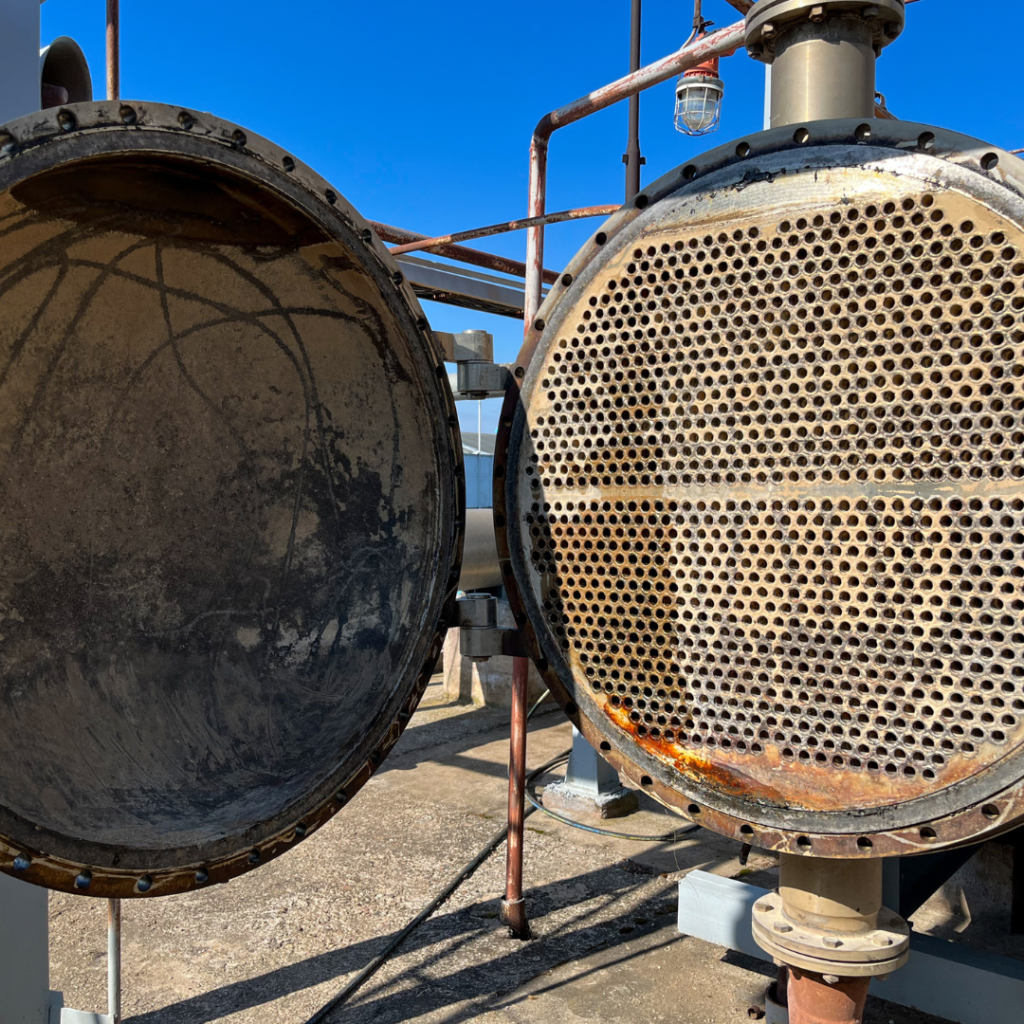
Tubular exchangers use round or cylindrical tubes instead of stamped panels. Because the geometry is rounder, thermal stress spreads more evenly as the metal heats and cools. There are fewer hot spots and fewer long seams sitting in the primary gas path.
That generally gives tubular designs better fatigue resistance. Generally, not always. They still fail, just in different places. Pay attention around the connections where tubes meet the end plates or collector box, and at any tight bends in the tube run. Corrosion also deserves a look, since moisture and combustion byproducts can wear on metal that otherwise holds up well to cycling.
A tubular exchanger that looks clean at first glance can still have trouble hiding at a joint. The inspection habit that pays off here is following each tube from one end to the other instead of glancing at the middle and calling it good.
Serpentine: Efficient, Compact, and Picky About Bends
A serpentine design routes combustion gases through a tube or channel that doubles back on itself in an S or M pattern. The longer, more twisting path pulls more heat out of the gas in a smaller space, which is why you see it in compact, higher-efficiency equipment.
The tradeoff is geometry. All those turns create stress concentration points, and the sharp 180-degree bends are the usual suspects. Dimpled joints and assembly points can also be trouble spots as the unit accumulates heating seasons.
These are the failures that hide from a quick visual pass. The cracks can be tight, tucked into curves, and tough to see without good light and a clear idea of where they tend to start. This is where familiarity with the specific design earns its keep. Knowing the bends are the high-risk zone tells you where to put your eyes and your time.
Why the Type Changes the Way You Inspect
Here is the practical takeaway. A seam-focused inspection that suits a clamshell won’t serve you well on a serpentine, and a bend-focused habit from serpentine work might skip the edge seams a clamshell needs checked.
Age and condition still count for a lot. Design tells you where failure tends to begin, but the actual unit in front of you can surprise you. Corrosion, overheating from restricted airflow, and installation problems can damage any of the three. So treat type as a map, not a verdict.
For anyone running a crew, the question worth asking is simple. If one of your technicians opens up an unfamiliar design tomorrow, do they know where to start? Or do they do a general once-over and hope?
Building That Familiarity
You can read about these designs all day, and it helps a little. What really moves the needle is putting your hands on real units and seeing what failure looks like in each one. Cracks, corrosion, and warping don’t look like the diagrams. They look like metal that has lived a hard life, and recognizing that takes repetition.
That’s the reason we built our seminars around real equipment. Spending a day with dozens of actual heat exchangers does something a manual can’t do alone. It trains your eye.
Frequently Asked Questions
Clamshell designs have a reputation for seam-related fatigue, and many of them are simply old, which adds to the failure rate. That said, no type is immune. Airflow problems, corrosion, and poor installation can damage any of them, so inspection matters regardless of design.
Not necessarily. Serpentine designs concentrate stress at their sharp bends, so those areas need closer attention. The design isn’t weak by default. It just has predictable places where problems begin, and a trained technician knows to check them.
Clamshell units show stamped, paired sections lined up with the burners. Tubular units use round tubes. Serpentine units show a tube or channel that loops back and forth through a compact space. Manufacturer documentation for the specific model is the safest confirmation when you’re unsure.
It can play a part, but age, maintenance, airflow, and installation quality usually matter just as much. A well-maintained unit of any design may outlast a neglected one of a “better” design.
The overall process stays consistent: flame observation, visual inspection, listening, and documentation. What changes is where you focus. Edges and seams for clamshells, joints and connections for tubular units, and bends for serpentine designs.
Document its location and appearance specifically, tell the homeowner clearly what you found and what it means for safety, and discuss repair or replacement options. A cracked exchanger is a serious safety concern, so it shouldn’t be left undocumented or unexplained.
Know What You’re Looking At Before You Open the Cabinet
If your crew sees the same handful of furnace designs every week, good. But the day an unfamiliar one shows up on a cold-weather call is not the day to be learning it.
Heat Exchanger Experts runs one-day, hands-on seminars where technicians work with more than 70 real heat exchanger models across clamshell, serpentine, and tubular designs. The instruction comes from the Prach family, whose combined field experience tops 55 years. Group enrollment is available if you’d like your whole team on the same page before the cold sets in.
